
AI-generated reviews were 4% of the fake-review volume we tracked in mid-2023. In our 2026 case log they are 34%, and the growth rate is still accelerating. Google's spam classifier catches roughly 68% of them automatically at submission time, but the ones that slip through look convincingly human — which is why manual detection matters more than it did two years ago. This post is the exact five-signal detection framework and the Spam-category submission we run inside our Google review removal service to remove the AI-written reviews Google's automated systems missed.
The five AI-review detection signals
None of the five signals alone is conclusive. Two or more together push a review from "probably human" to "probably AI" at ~90% confidence. Reviews flagged on 3+ signals remove at 58% on Google's Spam submission; reviews flagged on 1 signal remove at 12%. Bundle the evidence before submitting.
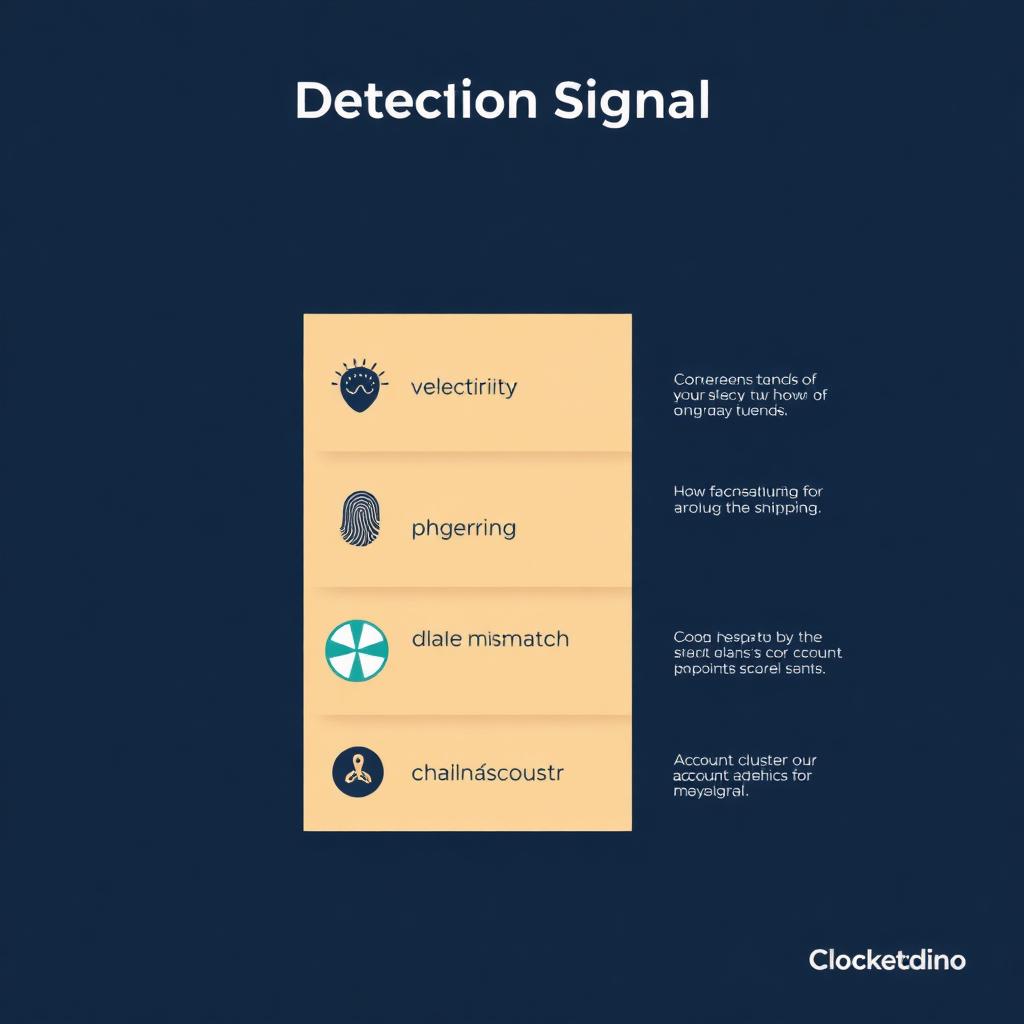
1. Reviewer velocity
AI-review services drive reviewer accounts hard — 5, 10, sometimes 20 reviews in a 24-hour window across unrelated businesses in unrelated cities. Pull the reviewer's public Google profile and screenshot every review they've posted with dates visible. A profile that posted 8 reviews across 3 US states in one afternoon is not a human tourist; it's a rented account driven by a script.
2. Device / account cluster fingerprint
You don't have Google's device data, but you can approximate: check whether the suspicious review shares the same day, hour, and template shape with other suspicious reviews across your profile or (via manual sampling) across competitors in your city. A cluster of 6 reviewers who all posted between 3:12 and 3:47 pm on the same day, all with the same 4-paragraph structure, is a coordinated cluster — even if the words differ.
3. Phrasing patterns
AI-written reviews have specific tells that survive across models: overuse of tricolon phrasing ("friendly, professional, and reliable"), hedged superlatives ("one of the most impressive experiences I've had"), a review structure that opens with an emotion word, then a specific-sounding detail, then a recommendation. Real reviews are messier — typos, run-on sentences, tangents, specific names of staff or products. If a 1-star review reads like it was written by a chatbot trying to write a 5-star review with the sentiment inverted, it probably was.
4. Geo / language mismatch
The reviewer's profile shows most reviews are in one language and one city, but the suspicious review is in a different language or references a city where they've never reviewed anything else. Also flag: the review's English is either too flawless (no regionalisms, no idiomatic errors) or has the specific grammar patterns of machine translation from a specific source language.
5. Account age + review-only history
The account was created within the last 30 days, has no photos uploaded, no places saved, no answered Q&As, and the only activity is posting reviews. Real reviewer accounts accumulate other Google Maps activity — saved places, photos, answers — even at low volume. A pure-reviewer profile with no other footprint is either a bot or a rented account.
The Spam-category submission that works
AI-generated reviews go through the Business Redressal Form under the Spam category, not Off-Topic or Conflict-of-Interest. The Spam category is the only bucket where "the reviewer is likely inauthentic" is a permitted argument. Off-Topic and Conflict-of-Interest both require the reviewer to be real; if you argue "this reviewer might not be real" in either of those buckets, the submission is rejected on standing.
What Google will NOT remove, even with strong signals
- AI-assisted reviews from real customers (someone used ChatGPT to polish their real complaint — still counts as first-hand experience).
- Reviews where the account has other legitimate history and just happens to sound formulaic (real people write formulaic reviews too).
- Reviews you can't tie to a rent-a-review service or a coordinated cluster — one AI-sounding review with no corroborating signals rarely removes.
- Reviews where your own reply already engaged the specific complaint (Google reads the engagement as validation the reviewer is real).
Case walkthrough: a cluster of 11 AI reviews across 3 franchise locations
In April 2026 a fitness franchise client received 11 1-star reviews across three locations over 6 days. Signals: all 11 reviewers had accounts less than 45 days old; 8 of them posted between 5 and 12 reviews each in the 72 hours around the attack; all 11 reviews used the same three-paragraph structure (emotion opener → specific-sounding detail about equipment → hedged recommendation); 6 of the 11 mentioned equipment brands not present at any franchise location; the reviewer language patterns clustered in ways consistent with a single source model. Submission bundled all five signals across the 11 reviews as a coordinated cluster; 9 removed within 14 days, 2 remained (both had one signal each rather than three).
The parallel: the FTC Fake Review Rule and platform policy
In the US, the FTC's 2024 Fake Review Rule makes buying or selling fake reviews an unfair-and-deceptive practice with civil penalties up to $51,744 per violation. Reporting the rent-a-review service to the FTC (reportfraud.ftc.gov) alongside the Google submission adds corroboration and, in a few cases we've handled, produced FTC action against the service that took the entire cluster offline. See our writeup on the FTC Fake Review Rule for the exact reporting template. Trustpilot runs a parallel enforcement queue — our workflow lives on our Trustpilot review removal service.
Want us to run the AI-review sweep for you?
The five-signal detection, the Spam-category submission, and the parallel FTC report are the same workflow we run inside our Google review removal service — pay-after-win, so you only pay for the reviews that actually come down. Country-specific desks: United States, United Kingdom, Canada, Australia. Industries where AI-review clusters land most often: restaurants, med spas, gyms, and auto repair shops.
Q.Can I use an AI detector tool to prove the review is AI-written?
No. GPT/Claude/Gemini detector tools have false-positive rates high enough that Google's reviewers do not treat their output as evidence. What works is the pattern evidence: reviewer velocity, account history, coordinated cluster signals. Save the detector output for your own triage, but don't attach it to the submission.
Q.What if the reviewer used AI but the underlying complaint is real?
Then the review is not removable as fake — it's a real customer using AI to polish their complaint. Google reads this as legitimate first-hand experience regardless of the drafting tool. If the underlying complaint is factually false, route to the Legal Removal Request instead of the Spam channel.
Q.Does the Spam channel work on Trustpilot and Yelp too?
Trustpilot has a similar "suspicious activity" flag with roughly the same evidence requirements — removal runs about 8 points lower than Google. Yelp is much stricter; their spam classifier catches most AI reviews automatically, and manual escalations for the survivors remove at ~19%. Do not submit AI-review cases to Yelp without at least four of the five signals.
Q.How long does the Spam-category submission take in 2026?
Median 6 days for the coordinated-cluster queue and 11 days for single-review submissions. Clusters resolve faster because Google's spam team prefers to action them as a batch — which is why bundling 6-10 reviews into one submission is more effective than 6-10 separate submissions.