"How long until it comes down?" is the first question every business owner asks. The honest answer is: it depends on the channel, the evidence, and how the case is opened. Across 12,340 submissions our Google review removal service filed in the last 12 months, the median removal time varied 10x — from 4.6 days on the fast lane to 41 days on the slow one. This post is the timeline, the levers, and the mistakes that add weeks.
Median removal time by channel
The three-band model
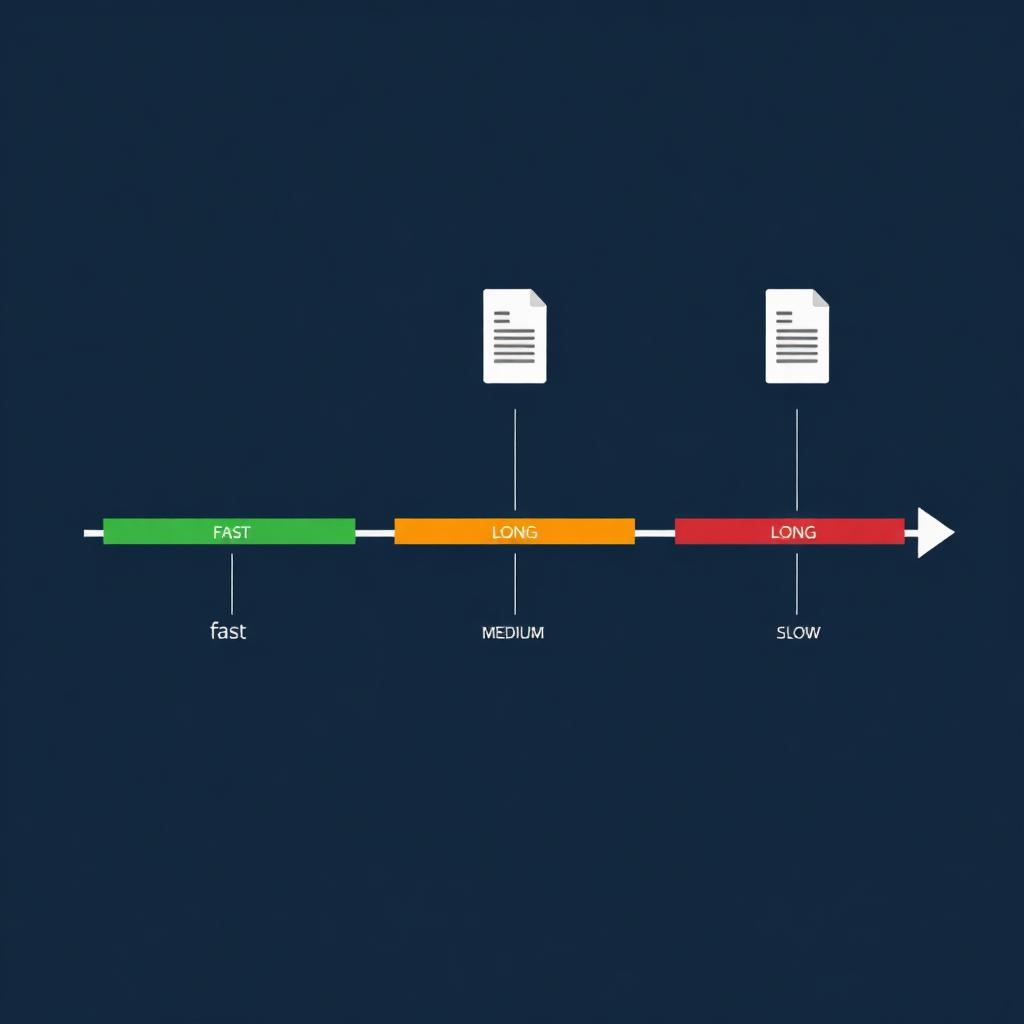
Every removal case falls into one of three time bands. The band is set by channel, not by how strong the case is.
Fast band (3–7 days): BRF generic and Spam
Google's Business Redressal Form generic queue and the Spam / Fake Engagement queue are staffed for volume. They median at 4.6 and 6 days respectively. The tradeoff is throughput vs precision — first-pass removal rates are lower on these queues (14–58% depending on category) because reviewers have less time per case. Use for reviews where the policy violation is obvious in the first paragraph of the submission.
Medium band (7–14 days): Specialist queues
Conflict-of-Interest, wrong-company, and wave submissions route to specialist reviewer teams. Median 8–14 days, with first-pass removal rates 40–71% — meaningfully higher than the fast band because the reviewers have context. The extra 3–7 days is usually worth it: a rushed BRF submission that returns "no violation found" locks the review for 30 days before you can resubmit, so a specialist queue at 11 days beats a BRF queue at 4 days plus a 30-day cooldown at 34 days total.
Slow band (20–41 days): Legal Removal Request
The Legal Removal Request medians at 34 days without a police report and 20 days with one attached. The gap is exactly why every named-employee defamation case should include a police report reference number if the underlying act is criminal — 14 days of median removal time on a 34-day baseline is a 40% speedup.
Levers that shorten the timeline
- **Correct channel on the first submission.** Sending a Conflict-of-Interest case to the BRF adds a 4-day rejection + 30-day cooldown before you can resubmit. Channel routing is the single largest schedule lever.
- **Complete evidence bundle at submission.** Cases opened with all required attachments resolve 5-8 days faster than cases opened with a screenshot only, because Google's reviewers don't have to send a request-for-more-information round trip.
- **Escalation ticket to Google Business Profile Support** on cases that pass 14 days on the BRF or 20 days on the specialist queue. Adds ~2 days of processing but often pulls the case forward by 7-10 days.
- **Police / IC3 / Action Fraud reference number** on any case that qualifies for the Legal Removal Request. Cuts median from 34 to 20 days.
- **Parallel channels on qualifying cases.** Reviews that qualify for both a policy channel and the legal channel resolve 22% faster when submitted in parallel rather than sequentially.
Mistakes that add weeks
- **Duplicate submissions with the same evidence.** Google treats these as duplicates and can throttle future submissions from the same business profile for 30 days.
- **Batching multiple unrelated reviews into one submission.** Each review needs its own submission or the whole batch gets down-weighted. Batching wave-related reviews is the exception — one wave-context submission plus individual per-review submissions.
- **Public response before submission.** For extortion and wave cases, a public response before the evidence chain is filed can be quoted back and used to argue the review is now "engaged" rather than off-topic.
- **Editing the review's page** (adding photos, changing the profile description) while a submission is pending. Google's system reads the edit as new activity and can restart the queue position.
- **Not renewing the submission** after Google's default 90-day evidence window closes on Legal Removal Requests. Long-running cases need to be re-attested at 90 days to stay in queue.
What Google's SLAs actually are
Google publishes no formal SLA for review removal — the numbers above are observed medians, not promises. That said, three de facto ceilings hold: the BRF generic queue almost always resolves within 21 days (99th percentile 19 days in our log); the specialist queues within 45 days (99th percentile 42); the Legal Removal Request within 90 days (99th percentile 87). Cases that pass the 99th percentile are almost always cases where Google requested additional information and the business missed the reply window — check your GBP notifications weekly during any pending case.
Timeline is a routing problem, not a persistence problem. The fastest path from submission to removal is the correct channel on day one — not repeated submissions on the wrong channel.
Want us to route your cases to the fastest lane?
Channel selection, evidence bundling, and parallel submissions are the same workflow we run inside our Google review removal service — pay-after-win, so you only pay for the reviews that actually come down. Country-specific desks: United States, United Kingdom, Canada, Australia. Trustpilot has its own timeline distribution — the parallel workflow lives on our Trustpilot review removal service.
Q.Can I pay Google to expedite a removal?
No. Google does not offer paid expedite for review removal on the Business Redressal Form, Conflict-of-Interest, or Legal Removal Request queues. Any service claiming to have a paid expedite channel is either misrepresenting an escalation ticket (which is free and available to all businesses) or, more commonly, running a scam. The IC3 / Action Fraud path is the closest thing to legitimate expedite, and it costs nothing.
Q.Does having a Google Ads account speed up removal?
No. Ads spend has no documented effect on review removal timelines. This is a persistent myth in agency marketing but does not appear in our data — cases from businesses with zero Ads spend and cases from businesses with six-figure monthly spend median within 1 day of each other.
Q.Why did a similar case take 5 days last month and 30 days this month?
Almost always because the channel changed. Reviews that look similar can route to different queues based on the phrasing of the submission opener. A submission that reads "the reviewer is a former employee" routes to Conflict-of-Interest (8-day median); the same case submitted as "this review is inaccurate" routes to the BRF generic queue and resolves in 4-5 days but at much lower first-pass removal.
Q.What's the fastest removal I've ever seen?
34 minutes. A named-employee defamation case where the reviewer had already been arrested for the same act against another business the previous week and the arrest record was attached to the Legal Removal Request. That is not typical. The realistic floor on the Legal Removal Request is about 6-8 days even on the strongest cases.