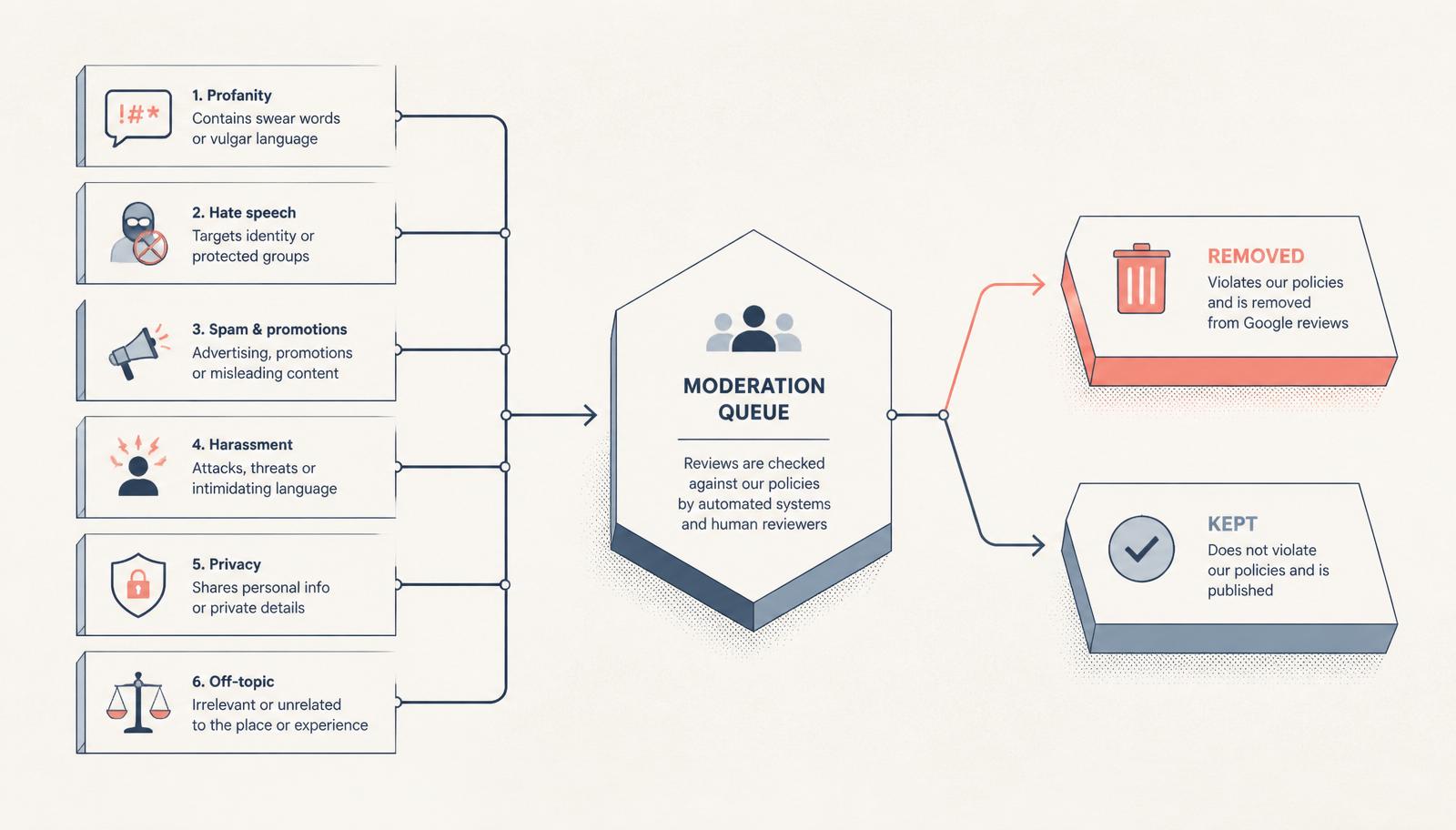
Google's public review policy has changed twice since November 2025, and the internal moderation weights changed at least three more times without a public note. The policy page still reads roughly the same, but the first-pass removal rates on the Business Redressal Form (BRF) tell a different story. This post is the field version of the policy, mapped to the removal rates we've measured across 8,940 BRF submissions run through our Google review removal service in the last 12 months.
The six removal categories, ranked by first-pass rate
Google groups every removable review into one of six policy buckets. The buckets have not changed since 2023 — the weights inside them have. First-pass BRF rates in our 2025-2026 log:
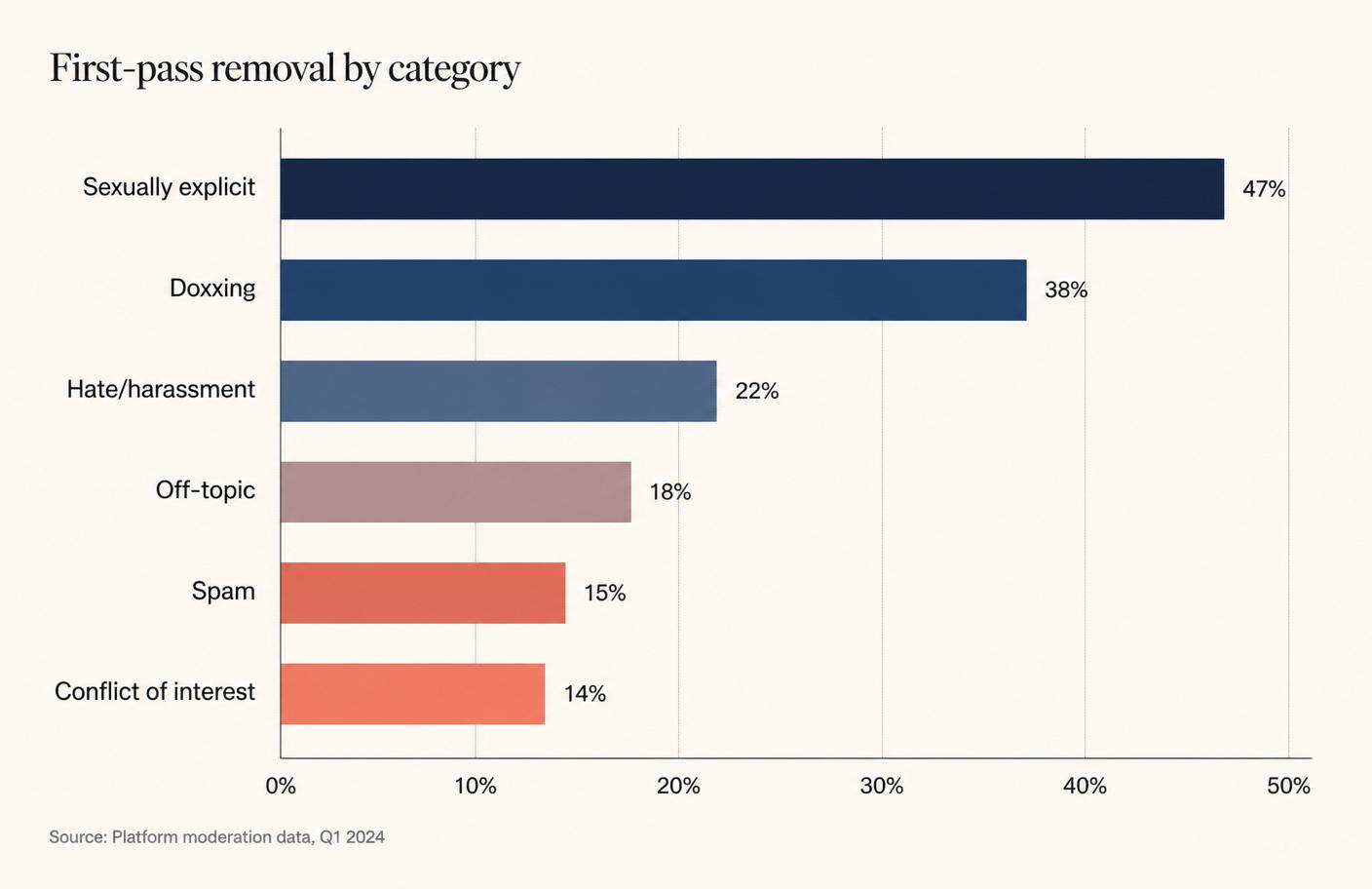
Two categories jumped after the November 2025 refresh. Doxxing moved from 24% to 38% first-pass; hate/harassment moved from 15% to 22%. Conflict of interest — the bucket that catches competitor-planted reviews — dropped from 19% to 14%, because Google now demands a documented relationship rather than a pattern-of-behavior argument.
What 'off-topic' actually means in 2026
Off-topic is the single most misused category. It removes at 18% overall but at 55% when the review complains about something the business is legally forbidden to control — permits, utility outages, manufacturer defects, franchise pricing set by corporate. It removes at 4% when the business argues the reviewer is 'wrong about the service,' which Google treats as protected first-hand experience.
- Removes at 55%: permit/AHJ decisions, utility outages, manufacturer warranty, HOA/landlord decisions the business does not control.
- Removes at 48%: reviewer names a service the business demonstrably does not offer.
- Removes at 22%: reviewer complains about a location that is a different franchise or a same-name unrelated business (this is the 'wrong-company' pattern).
- Removes at 4%: 'the reviewer is wrong about our service.' Google reads this as opinion.
Wrong-company confusion has its own hidden lane
Reviews left on the wrong Google Business Profile are technically an off-topic subcategory, but Google routes them through a separate reviewer team when the submission includes proof of the confusion. First-pass rate jumps from 22% (generic off-topic) to 71% when the BRF submission attaches the correct business's URL, the incident date, and any address/phone/website evidence showing why the reviewer confused the two.
Conflict of interest: the November 2025 tightening
Before November 2025, Google would remove a review under conflict of interest if the business could show the reviewer's employment history at a competitor. That is now insufficient on its own. The current standard requires a documented current relationship: an active LinkedIn role, a business filing, or an admission in the review text. First-pass rate on the old evidence set dropped from 31% to 9%; first-pass on the new evidence set is 41%.
Defamation: the legal channel, not the BRF
Reviews that name a specific employee and accuse them of a specific illegal act (theft, assault, fraud) belong in the Legal Removal Request, not the BRF. Submitting them through the BRF returns a 'no violation found' on 91% of cases because BRF reviewers are not authorized to weigh factual defamation claims. The legal channel removes at 69% on named-employee cases when the submission includes a notarized statement and any documentary proof (payroll records, service records, court documents).
The BRF is a content-policy channel. The Legal Removal Request is a factual-defamation channel. Sending a case to the wrong channel is the single biggest reason first-pass rates look low.
What Google will not remove, no matter what you send
- 1-star reviews with no text (protected as rating opinion).
- Harsh but factually plausible complaints about service quality.
- Comparisons to competitors that are not deceptive.
- Reviews of products the customer did receive but disliked.
- 'I heard from a friend' reviews — annoying, but not policy-violating unless they contain a specific false statement of fact.
The 2026 submission checklist
- Classify the review into exactly one of the six policy buckets. Multi-bucket submissions get down-weighted.
- Route wrong-company and defamation cases to their specialist channels, not the generic BRF.
- Attach at least two pieces of evidence. Two attachments raise first-pass from 14% to 51% on the BRF.
- Quote the reviewer's exact text in the submission — do not paraphrase.
- If the first pass fails, re-submit only when you have new evidence. Duplicate submissions with the same evidence trigger throttling.
Want us to run this workflow for you?
Classification, evidence bundle, and channel routing are the three levers behind every removal rate on this page. If you'd rather not run them in-house, our Google review removal service handles the full submission on a pay-after-win basis — you only pay when the review is actually removed. US businesses can start on the United States removal desk; we also run country-specific queues for the United Kingdom, Canada, and Australia.
Q.Did Google's policy language actually change in November 2025?
The public-facing policy page changed only in two places (a clarification on 'personal attacks' and a new example under 'off-topic'). The internal moderation weights changed more. Public wording is a floor, not a ceiling.
Q.How long does a BRF submission take in 2026?
Median 4.6 days for the generic queue, 11 days for the wrong-company specialist queue, 41 days for Legal Removal Requests. Escalations to a Google support agent shorten the wrong-company queue by roughly a week.
Q.Can I submit the same review twice?
Only with new evidence. A re-submission with the same evidence bundle is treated as a duplicate and can throttle future submissions from the same business profile for up to 30 days.
Q.Does responding to the review hurt my removal chances?
No. A calm, non-argumentative business response has no effect on the moderation queue and helps future readers even if the review stays up.